Like most aspects of this project, it took the research team some time to land on a name for our work and how we could communicate it easily.
LARCH is an acronym that helps us quickly communicate (most) of the keywords that inform this project: Language, Race, Policy, Contemporary History, Canada.
LARCH wasn’t just the best acronym to capture our project’s core ideas—it also, by happy coincidence, is the name of a tree that offers powerful metaphors for framing our research.
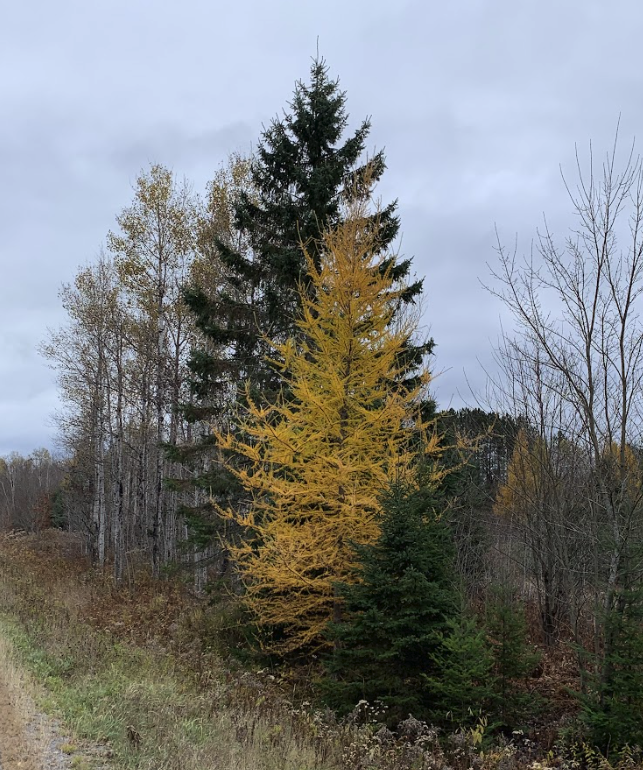
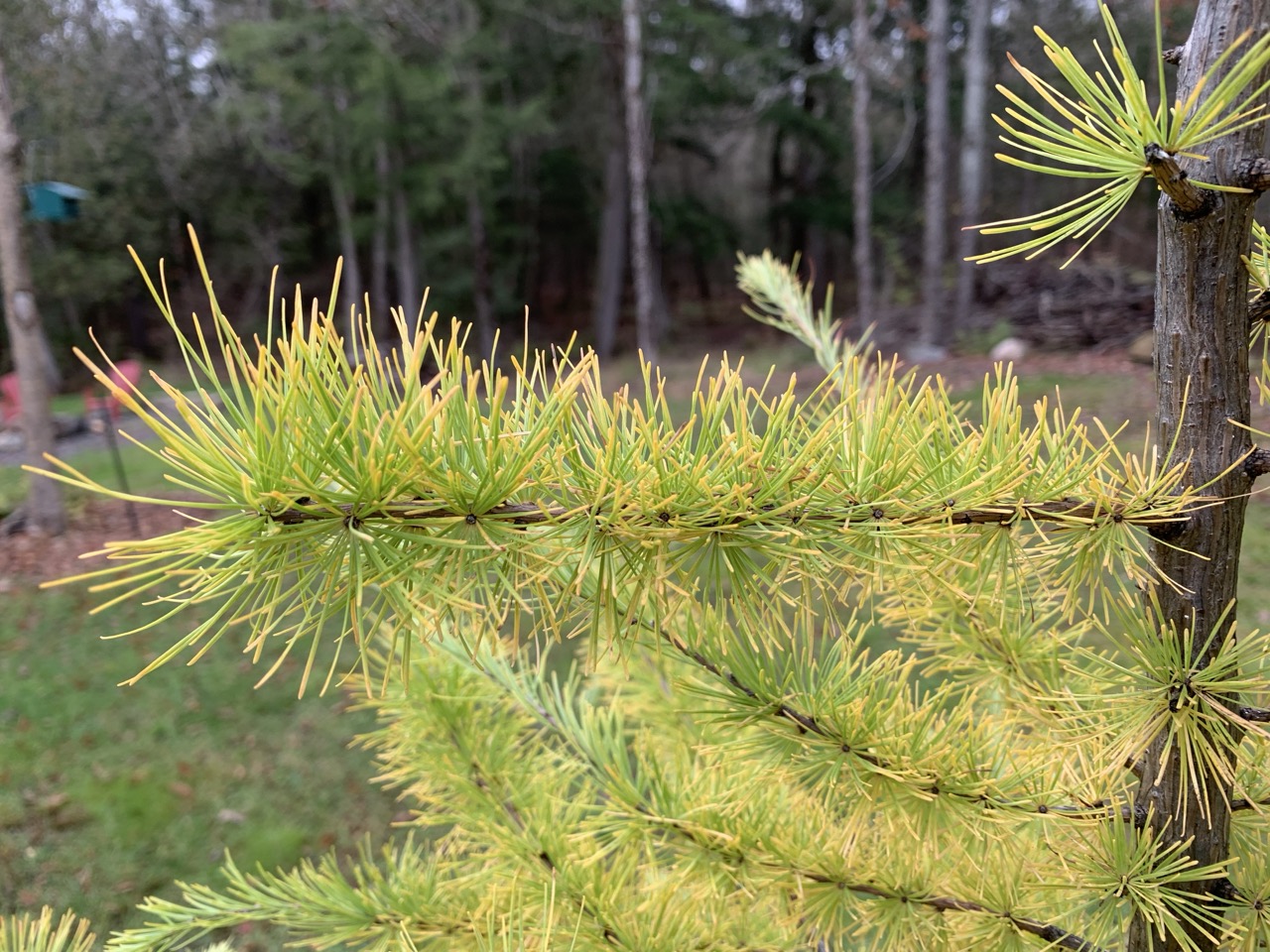
Despite the standard scientific classification of trees into deciduous and coniferous, larches stand out as hybrid: a tree with needles and cones but that also changes its colours in fall, becoming a brilliant shade of yellow.
This hybridity fits our project well in that the stories we tell on this website challenge the binary or static thinking that is so common in discussions of language and race in Canada. Languages in Canada are assigned fixed categories: official, minority, Indigenous, heritage, and so on. These categories have no internal meaning. Their meaning is only possible by placing them in opposition to one another.
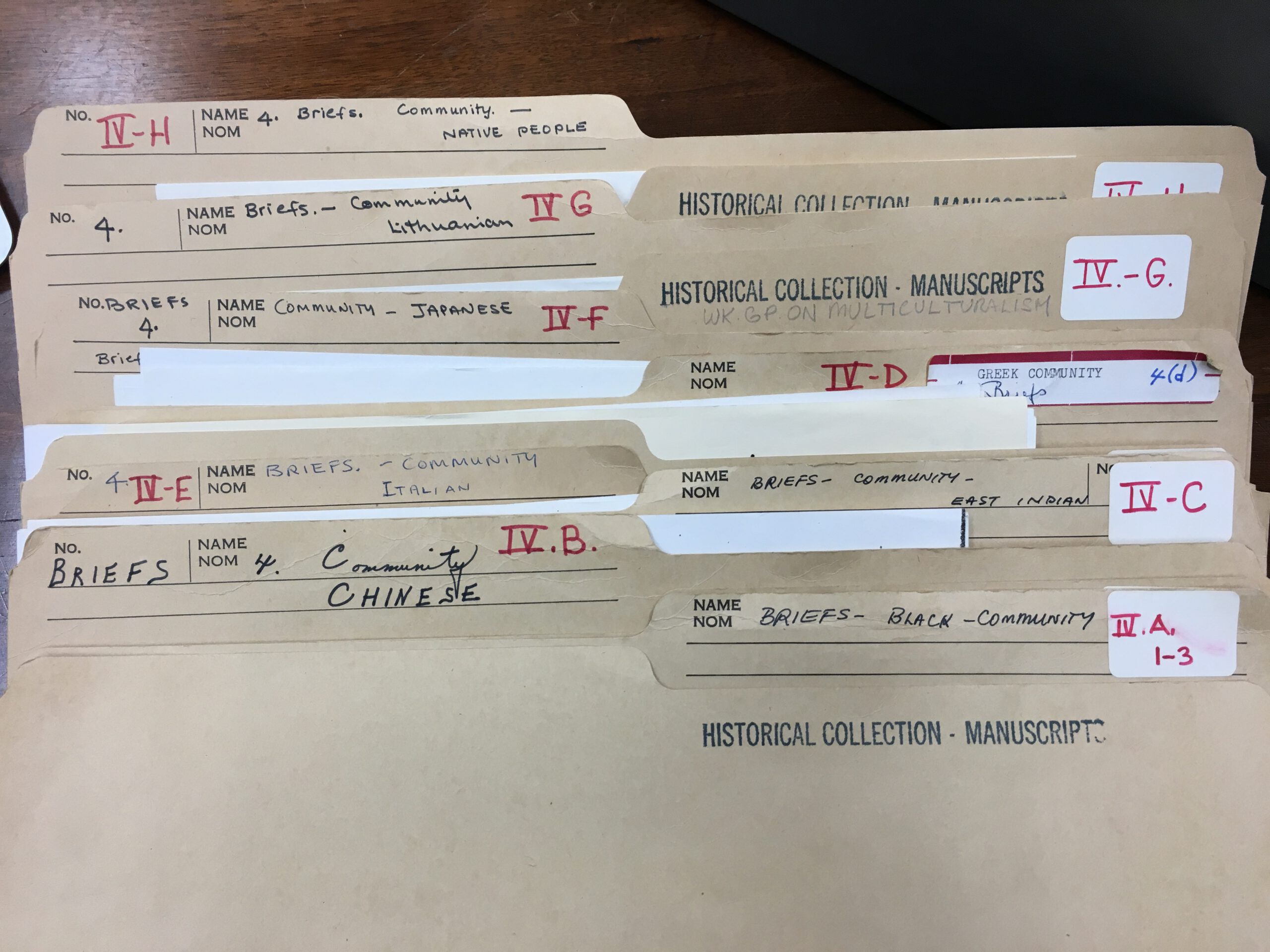
The data in our project are also organized in ways that reflect binary or static thinking. As we dug into the archives, we encountered box after box with records organized by discrete racial, ethnic, and/or linguistic categories. This structure must have made sense to the Board and Ministry staff who created these files decades ago. But if we’re not careful, this structure can also affect our understanding of past debates over linguistic and racial diversity and encourage us to see them as debates between static, separate “racial” or “ethnic” communities.
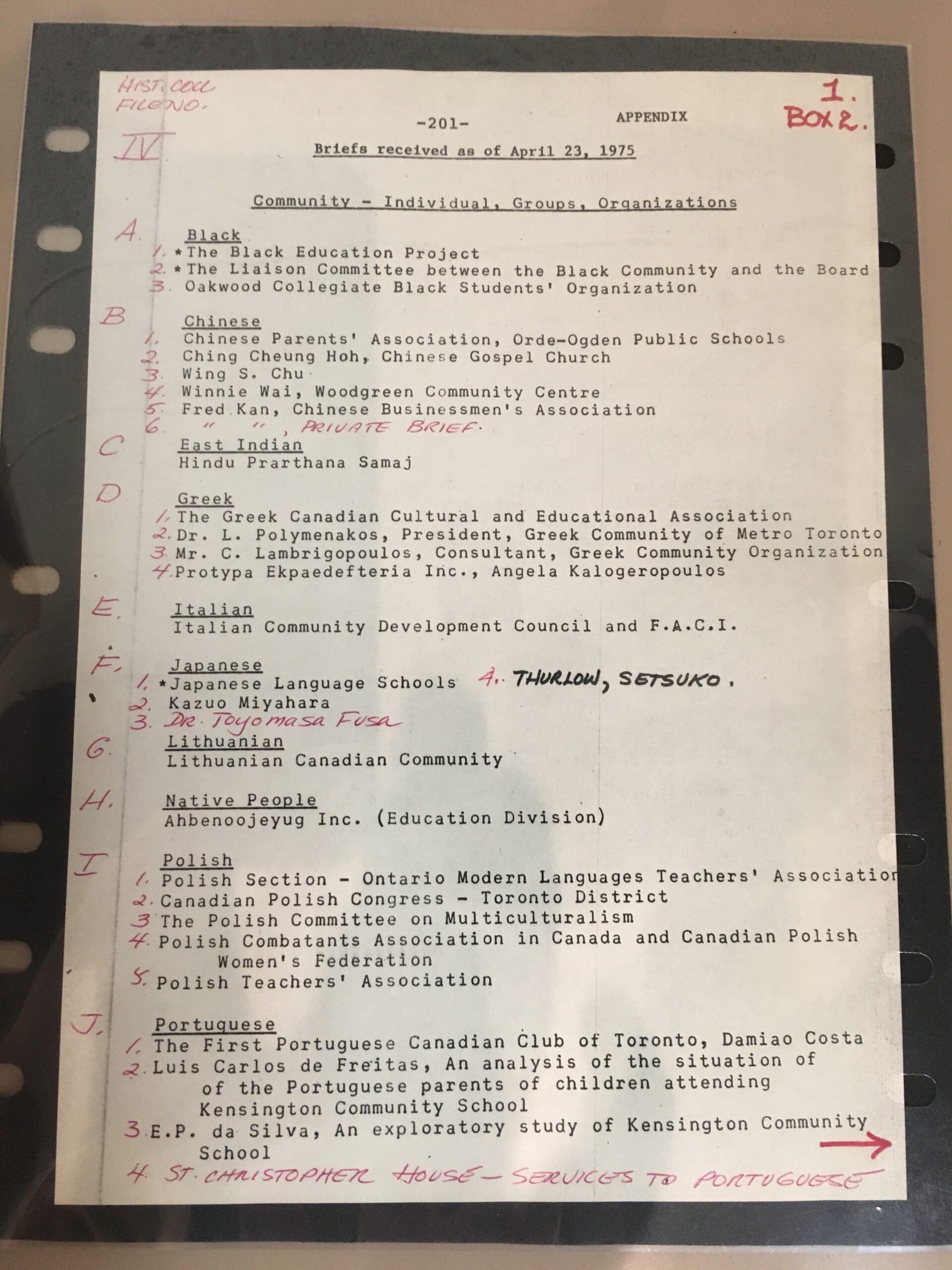
Our project starts from a different premise, namely the interconnectedness of the many languages spoken in Canada and of the people who speak them.
For example, “heritage language learners” also learn Indigenous languages, English, and French. It makes little sense to maintain the artificial boundaries constructed between these different ‘kinds’ of languages, since they are present in Ontario schools at the same time, often spoken or learned by the very same people.
In a similar way, our project has never sought to identify what “THE” Italian community thought about heritage languages, or what “THE” Black community thought about language and culture programs. Instead, we have taken for granted that multiple interpretations of language and culture and their role in school circulate within communities otherwise assumed to be homogenous.
As important, we have taken for granted that individual people played multiple roles in these stories about linguistic and racial diversity. For example, one of our oral-history participants is not only an “immigrant” and thus a member of one of the communities constructed in the photos above. But she is also a researcher and a parent of a child who attended heritage language classes herself. There is no way to “assign” this participant to a single community. Instead, we have to understand the hybrid and dynamic ways she engaged in advocacy for linguistic diversity in Toronto schools.
The hybrid, dynamic nature of larch trees helps us remember these intellectual assumptions and analytical goals.
Larch trees also provide a helpful metaphor for theories of change and the relationship between the past and the present.
Our project doesn’t start from a premise of progress or that “it gets better” over time. Just as larch needles burst out of nodes along the branch, rather than in a sequential or patterned way, we understand that change is often the result of explosive, seemingly random dissent or even conflict.
The Heritage Languages Program is a good example. On the one hand, the program seemed to appear out of nowhere, proposed in a Throne speech in March 1977 and later announced via memo to school administrators. On the other, this policy was related to previous dissent, intervention, and conflict as various racialized and language-minoritized communities organized to expand linguistic and racial justice in Toronto schools. Once the HLP existed, it then served as a node around which explosive conflict was centered. Part of our project’s goals is to recover these conflicts and understand what animated them.
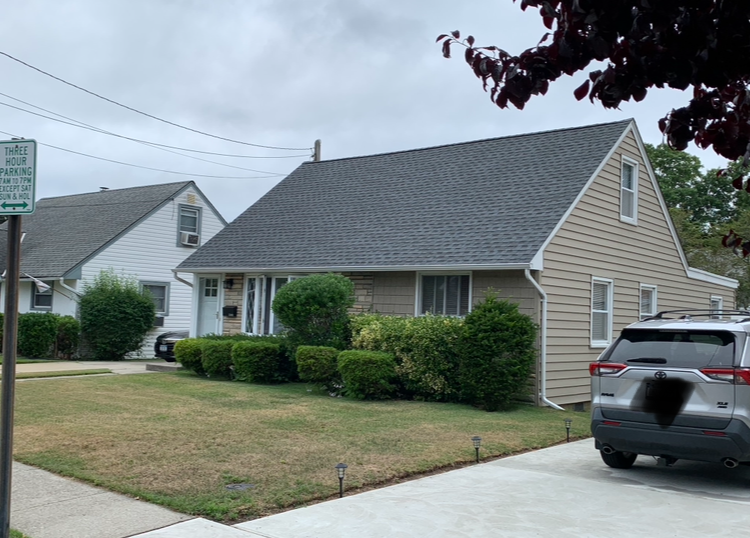
Finally, and on a personal note, larch trees are also meaningful to Jeff, the PI for this project. The house his family lived in when he was born is on Larch Street in a suburb of New York City. Jeff’s parents were born in Canada, his father in Port Arthur (now part of an amalgamated Thunder Bay) and his mother in Winnipeg. This historical accident gave him automatic access to Canadian citizenship, even though he didn’t live here full-time until 2014. Most of his extended family lives in the Prairies and Western Canada. He grew up bouncing back and forth across the border, visiting family, working in an auberge in Montreal in the summer of 1995, just a few months before the referendum (talk about explosive conflict!). This form of hybridity also informs our project but it is also a lovely serendipity that it all began on Larch Street.
Many of the projects shared on this website are about policy, but we don’t spend a lot of time analyzing specific documents created by the government.
Instead, we are interested in how language policies become sites of conflict over broader social questions. This requires looking not only at policy texts, but also at real people: how people give meaning to, form relationships around, and build worlds in relation to policy texts.
We understand that the state (and other formal governance bodies) try to influence, even control, social behaviour through (language) policy.
We agree with Eve Haque and Donna Patrick, who describe how language policies “have been used in Canada … to manage racial difference through processes of erasure, forced assimilation, and exclusion through the technology of language” (2015, p. 27, our emphasis). We also agree with Elana Shohamy, who has described language policies as mechanisms the state uses to enact certain agendas (often hidden) regarding language in society.
These metaphors of technology (as in “tool”) and mechanism can imply that the thing itself, policy itself, is static or fixed. By contrast, we view language policies themselves as highly unstable.
Take “heritage language” as an example. In the 1970s and 1980s, people who debated over the Heritage Languages Program and what it should or shouldn’t do in Ontario schools had widely divergent understandings of what a “heritage language” even is. Indeed, as Mayo Kawaguchi argues in her dissertation, in most cases, the only way people could define a “heritage language” is by telling you what it is not: not one of the official languages, not an Indigenous language, not a sign language. In other words, the term is possible only through trying to establish a binary opposite, an Other. This makes the term inherently unstable.
As a consequence, not only are language policies contested because of the control they seek to exert on people – sometimes people simply resist the aims of a given language policy or think those aims don’t go far enough.
But also, language policies often become social battlegrounds because the people implicated in a given policy often have hugely different understandings of the key ideas and terms involved.
The starting point for our project is understanding that ‘language’ and ‘race’ work together to shape the world we live in.
Eve Haque’s (2012) analysis of the Royal Commission on Bilingualism and Biculturalism, and the Canadian policies of official bilingualism and multiculturalism that stemmed from it, is a key reference point for this project.
This project is built on historical research on policies about heritage languages in Canada. In the long history of migration in modern Canada, heritage language education has been practiced at home and in communities; however, the educational policies of these languages have been rarely recognized as part of the history of education in the country.
Our project’s interest in historical inquiry lies in understanding the present educational limitations and potentials by examining the past policy actors’ conflicts and ideations for integrating multilingual educational theories and practices into Canadian schools. This stance on historical inquiry aligns with exploring the “history of the present” (Garland, 2014) to draw genealogies of marginalized knowledge within the dominant power mechanisms. This approach also allows us to focus on the present in a way that decolonizes a given condition of historical knowledge, which has normalized Eurocentric ideological views on the primitive past and the progressive future.
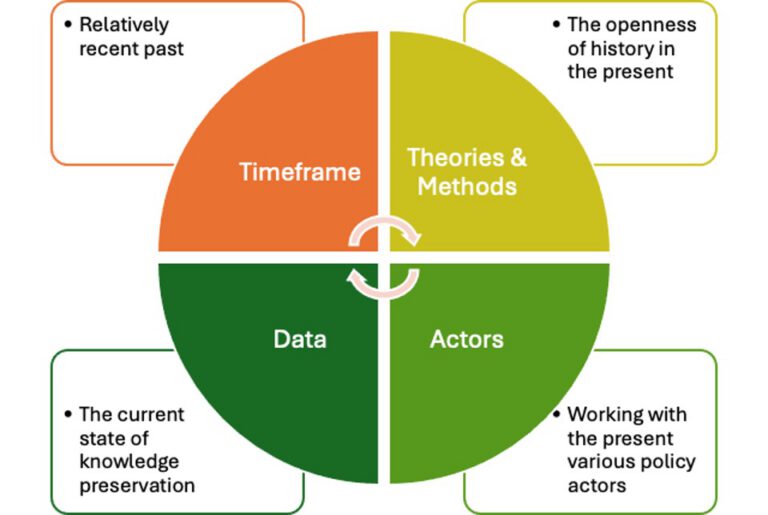
Uncovering the multiple nodal points to rediscover the present systematic and ideological problems in hidden traditions, the project’s historical research practices encompass these four areas of contemporaneity.